The circular economy has become a buzzword of late, but the time has come to move from theory to practice. Transitioning towards a circular economic model is increasingly recognized as essential for ensuring the long-term sustainability of human activities – and the fisheries and aquaculture sectors are no exception.
What is the Circular Economy?
The circular economy is a production and consumption model based on sharing, leasing, reusing, repairing, refurbishing, and recycling existing materials for as long as possible. This approach extends the life cycle of products, minimizes waste, and reduces resource exploitation. At the end of a product’s life, its materials are reintegrated into the value chain to create new worth.
In a circular economy, economic growth is decoupled from the consumption of finite resources. Supported by renewable energy, this model regenerates natural systems while generating economic and social value.
Within the RECONNECT project, three key components define the circular economy approach:
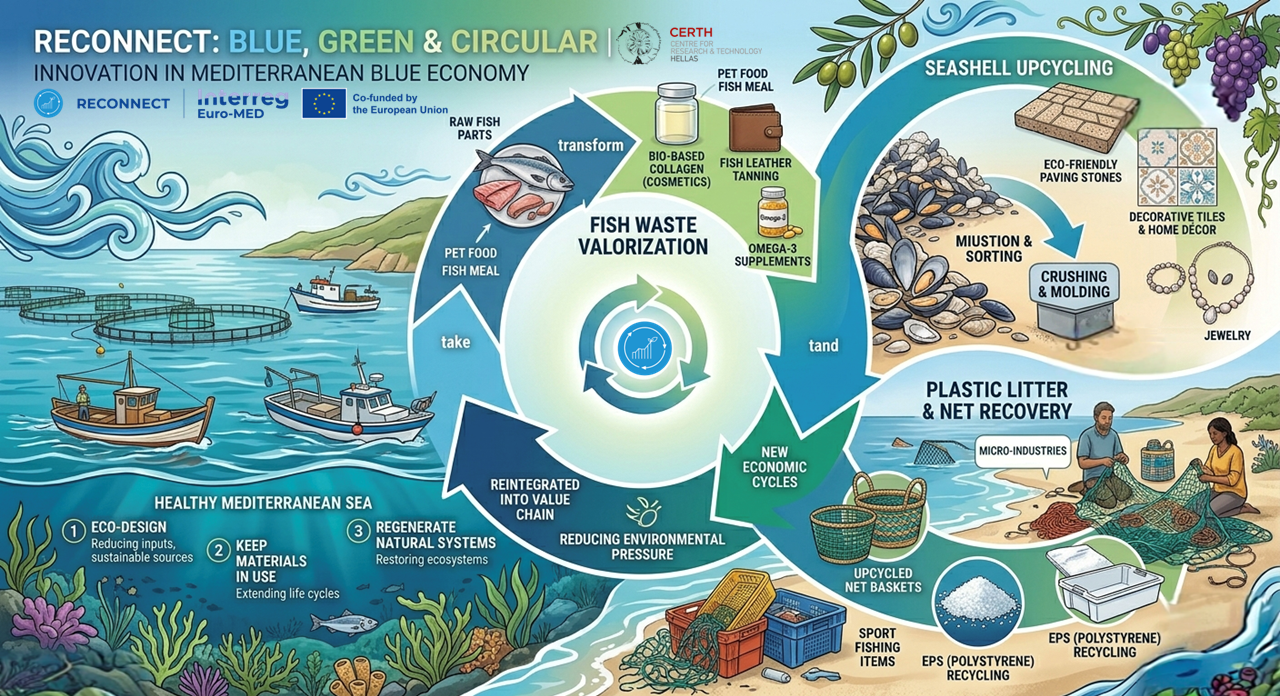
- Eco-design – Designing products that require fewer raw materials, prioritizing sustainably sourced inputs, and reducing waste and pollution from the outset.
- Keeping products and materials in use – Extending life cycles through reuse, repair, sharing, recycling, symbiosis and reconnecting previously disconnected actors.
- Regeneration of natural systems – Restoring ecosystems through methods such as composting, anaerobic digestion, or bio-based recovery processes.
Why Circularity Matters for Fisheries and Aquaculture? In Mediterranean fisheries and aquaculture, valuable biological resources are often discarded as waste. As resource depletion, pollution, deforestation, and landfill saturation reach alarming levels, the need for a systemic shift is urgent. However, consumer habits, resistance to change in production practices, and established vested interests often hinder progress.
This is exactly where RECONNECT can make a difference!
RECONNECT’s Role: From “Take–Make–Dispose” to Circular Innovation. RECONNECT helps businesses and communities overcome the limitations of the traditional linear model by promoting industrial symbiosis, cross-sector collaboration, and innovative uses of residues from fisheries, aquaculture and algae-based activities. The project introduces new open-innovation pathways connecting large industries, SMEs and craft enterprises, AI-based tools and circularity methodologies that simplify collaboration between sectors, pilots that demonstrate real, replicable solutions for reusing waste and creating high-value bio-based products, capacity-building and knowledge-transfer activities to empower SMEs to adopt circular practices and a transnational network that will continue promoting sustainable practices beyond the project’s end.
By reconnecting technology, business models and craft creativity, RECONNECT provides practical tools to regenerate resources, reduce environmental pressure and generate new opportunities for businesses and communities.
The shift to a circular economy is not merely an environmental choice – it is a strategic economic opportunity. RECONNECT demonstrates that circularity can foster new relationships between sectors that share the same territory but rarely collaborate. Through symbiosis, residues become resources, waste becomes value, and innovation becomes accessible to all.
In a world where ecosystems are under strain and change is unavoidable, RECONNECT offers enterprises and communities the means to act, adapt and thrive – bringing the blue, the green and the circular together into one forward-looking vision.
Awareness-Raising to Change Mindsets and Behaviours
Shifting mindsets is one of the most powerful tools for driving sustainability. Encouraging producers, consumers, and the administration to rethink how products are sourced, designed, and used is essential for reducing environmental impact. Without meaningful behavioural change, the benefits of end-of-life measures – such as recycling – will always remain limited.
More sustainable sourcing of raw materials is a fundamental part of this transition. Within RECONNECT, we actively support actions that foster responsible material use from the very beginning of the production chain.
Sustainable Production Starts at the Source. While the EU sets ambitious goals for recycling and waste reduction, much more is needed to shift practices at the start of the product cycle. RECONNECT is uniquely positioned to support change where it matters most – at the level of fishermen, aquaculture producers, and SMEs in the blue economy.
Promoting locally sourced and sustainably caught fish is an essential first step towards a more circular value chain. The next step is ensuring that products derived from this fish generate minimal waste across their entire life cycle – whether in terms of energy use, packaging, or untreated organic materials.
-
Turning Challenges into Value
New Uses for Fish Waste
RECONNECT encourages and supports initiatives that transform residues from fisheries and aquaculture into valuable resources. By analysing for example which enterprises and business land species which cannot be sold for human consumption, and in what quantities, the project aims to identify realistic opportunities for reuse.
However, as noted by our Greek partners, local quantities of discards can be small, raising concerns about whether they can supply a stable resource stream on their own. This highlights the need for enhanced cooperation – potentially at European scale or with larger industrial players – to achieve the critical mass needed for new circular business models.
Across Europe, several inspiring circular economy solutions already demonstrate how fish waste can power new industries: France and Finland have supported local fish-skin tanning activities through EU-funded programmes. These initiatives trained local artisans, engaged fishers and aquaculture producers, and created new value chains around what was once waste.
Beyond tanning, fish by-products are being transformed into pet food, fish meal for aquaculture, and other bio-based materials. In Italy, particularly Sardinia, new ventures explore the use of fish-derived organic materials in the cosmetics industry, showcasing the potential for high-value niche markets.
Innovation thrives when knowledge and experience are shared. RECONNECT is building a transnational network that brings together all stakeholders – from fishers and SMEs to researchers, institutions, and industry leaders – who are interested in improving the valorisation of underused resources.
The goal is to combine practical project experience, scientific insights, and market knowledge to develop economically viable, scalable solutions for managing raw material streams. By connecting regions, sharing best practices, and supporting experimentation, RECONNECT helps ensure that new circular models can be replicated, adapted, and sustained across the Mediterranean and beyond.
She Sells Seashells
Shellfish producers know all too well the challenge posed by the mountains of discarded shells left behind after mussels, oysters, clams, and other species are processed. These shells take up space, generate unpleasant odours, and require disposal – costing both time and money. But what if shells were no longer a burden, and instead became a valuable raw material?
Across Europe, innovative projects are already transforming shell waste into new products. In France, research has explored the conversion of ground shells into agricultural lime or supplements for poultry feed. European funding has also helped a local enterprise source scallop shells to create eco-friendly paving stones. Containing 30 to 40% scallop shells, these paving stones are more porous than traditional ones, allowing for better rainwater infiltration and helping to reduce flooding risks. In Sardinia, entrepreneurs have developed a business that uses crushed mussel shells to craft items such as kitchen tiles, home décor objects, and jewellery. These examples show that, when creativity meets circular thinking, even low-value waste can become an engine for innovation.
Identifying the right project promoters, securing investment, and designing viable business models is not always easy. Yet experience repeatedly demonstrates that opportunities are plentiful – waiting for the right combination of ingenuity, collaboration, and support. By inventing new ways of working and managing our resources, European enterprises can protect marine and terrestrial ecosystems that are essential for human wellbeing and economic resilience.
From Problem to Circular Potential Tackling Plastic Waste
Every year, one million tonnes of plastic litter ends up in our seas and oceans. According to the EU’s Strategy for Plastics in the Circular Economy, single-use plastics and fishing gear together make up 70% of Europe’s marine litter. Fishing gear alone – nets, lines, floats, traps – accounts for 27% of beach litter and roughly half of the Great Pacific Garbage Patch. Durable by design, fishing lines can take up to 600 years to degrade, yet only 1.5% of them are currently recycled.
Across Europe, innovative businesses and community initiatives are working to reduce the plastic that ends up in landfills or the marine environment by extending its life or giving it a second purpose. Supported interventions include cleaning and repairing plastic crates in fish auctions to extend their lifespan, developing biodegradable meshes for mussel cultivation, recovering, sorting and reusing litter found in fishing nets, improving port-based waste collection and recycling systems and exploring new uses for old fishing nets and other discarded plastics, through research and demonstration actions.
Many creative ideas are already proving successful. Old nets can be repaired, reused, or transformed into baskets, placemats, clothing, football nets, or garden furniture. In some Spanish regions, these practices have even sparked new micro-industries. In Asturias, two net-menders opened a craft shop selling souvenirs and sport fishing items made from recycled nets. In Galicia’s Costa da Morte, cockle pickers from Anllons learned how to make baskets and bags from discarded fishing materials. More advanced recycling initiatives are also emerging. A project in Denmark, for example, processes expanded polystyrene (EPS) into plastic granules that can be sold to the plastics industry to manufacture a wide range of new products, including fresh fish boxes.
For RECONNECT, the challenge – and the opportunity – is to identify entrepreneurs with the vision and determination to transform waste from fisheries and aquaculture into valuable materials or products, and to connect them with the right partners. That includes technical experts, scientists, manufacturers, designers, and innovation intermediaries capable of turning good ideas into market-ready solutions.
By fostering collaboration, promoting circular business models, and building transnational networks, RECONNECT helps ensure that materials once considered waste – shells, nets, plastics, organic residues – are reintegrated into new economic cycles. This approach not only protects the marine environment but also supports innovation, local craftsmanship, and sustainable economic development across the Mediterranean.
“At CERTH – CPERI, we are proud to contribute to RECONNECT — a project that aligns closely with our vision of innovation driven by impact. By uniting tradition, technology, and sustainability, RECONNECT amplifies the role of small craft-based businesses and highlights how the blue economy can evolve in a circular and inclusive way.”